Monday, July 27, 2026
History
This Post Office invites visitors to step back in time
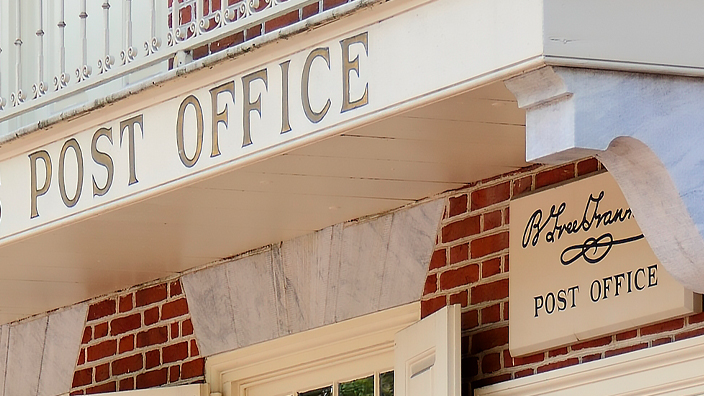
The B. Free Franklin branch has a Colonial appearance and history
On July 26, 1975, the public was invited to preview the opening of the B. Free Franklin Post Office in Philadelphia.
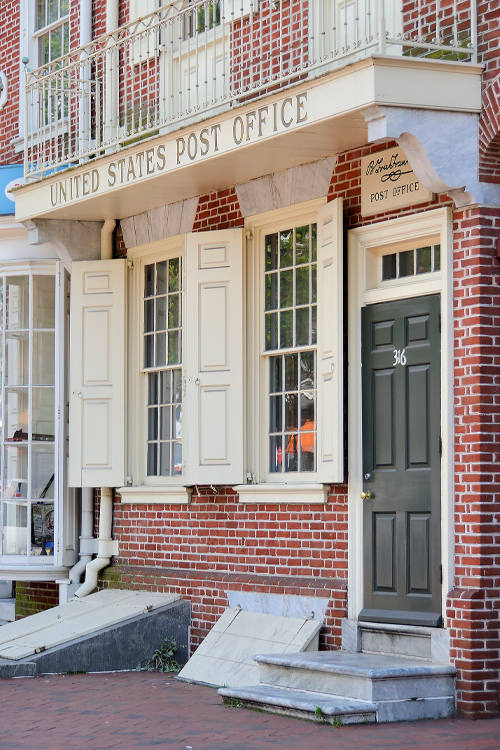
The new Post Office celebrated the 200th anniversary of the Postal Service and the date in 1775 when the Second Continental Congress appointed Benjamin Franklin postmaster general. In addition to commemorating the Founding Father’s postal role, the branch was established to honor the nation’s bicentennial the following year.
Both the selection of the Post Office’s site and its “B. Free Franklin” moniker are significant.
The Post Office building, a three-story rowhouse located at 316 Market St. in the heart of the City of Brotherly Love, was owned and occupied by Franklin from 1737 to 1753.
The building itself did not function as a Post Office during Franklin’s time. However, it was refurbished to reflect the Colonial era in appearance, and its employees dressed in period costume.
Franklin was first appointed postmaster of Philadelphia in 1737 for the British Crown and later became co-postmaster general with William Hunter of the British North American colonies. He served in that position from 1757-1774 and is credited with increasing the efficiency of the post through improvements in bookkeeping and delivery routes.
Franklin was appointed postmaster general under the authority of the Second Continental Congress and served from 1775-1776.
When he became a postmaster, Franklin used the “B. Free Franklin” signature on letters he sent. It is generally assumed his use of the word “Free” between his first initial and surname was in protest of British rule and a patriotic reference to the American struggle for freedom. However, according to USPS Historian Stephen Kochersperger, as postmaster Franklin was allowed to send his letters without paying postage — a practice afforded certain government officials called “franking.”
“Franked letters had to include the word FREE and the signature of the sender. Ben cleverly combined both items into B Free Franklin, which has retroactively been interpreted as a political protest against British rule. This claim doesn’t hold up under scrutiny — Franklin was a loyal officer of the Crown until he was fired in 1774. He never opposed British rule before that,” he said.
The B. Free Franklin Post Office opened for two days in 1975 — July 26-27 — with Postal Service and National Park Service officials taking part in a ceremony. The site then closed for construction of the attached Franklin Court Complex to be completed.
The branch reopened on Sept. 3, 1975, and includes a museum of postal history. It is a partner site of Independence National Historical Park, which the National Park Service maintains.
Today, if customers want to mail a postcard or letter from this location, postal employees there will hand cancel the stamp using Franklin’s “B. Free Franklin” signature postmark.
The B. Free Franklin Post Office most recently served as the site of the Declaration of Independence stamp dedication on July 4 in celebration of the U.S. semiquincentennial.
The “History” column appears occasionally in Link.
Heroes
He freed a child from a car seat
The customer’s grandson had become entangled in a shoulder belt
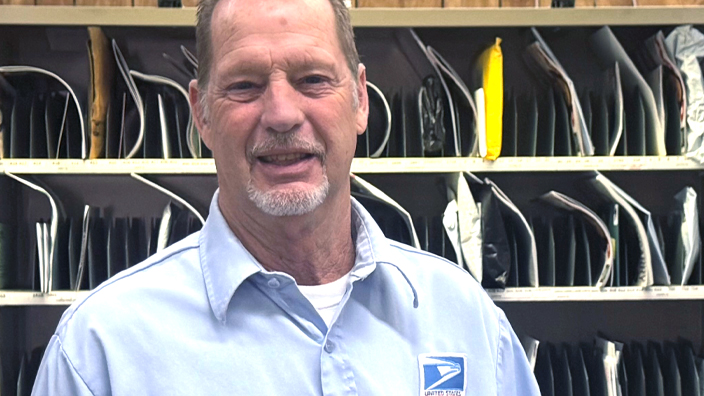
Letter Carrier Charles Koontz was delivering mail in Lexington, NC, recently when he heard a woman yelling for someone to call 911.
The Postal Service employee parked his vehicle and ran over to the woman, who was standing by her car with the rear driver’s side door open.
The woman’s granddaughter had put her younger brother in the car seat incorrectly, and the child had become entangled in the shoulder seat belt. The strap was across the child’s neck, and he was screaming as the strap tightened.
Koontz called 911, then tried to cut the strap with a knife he had on him. When the knife didn’t work, he asked for scissors, which he used to cut the strap and free the child.
He stayed with the family until paramedics arrived. The child was not injured.
Employees featured in “Heroes” receive letters of commendation through the Postmaster General Heroes’ Program. The nomination form is available on Blue.
Week in Review
Here’s what Link covered July 19-25
A 19th-century PMG and a South Dakota volunteer made news
Last week, Link alerted readers to a new postmaster general biography added to the postal history section on usps.com.
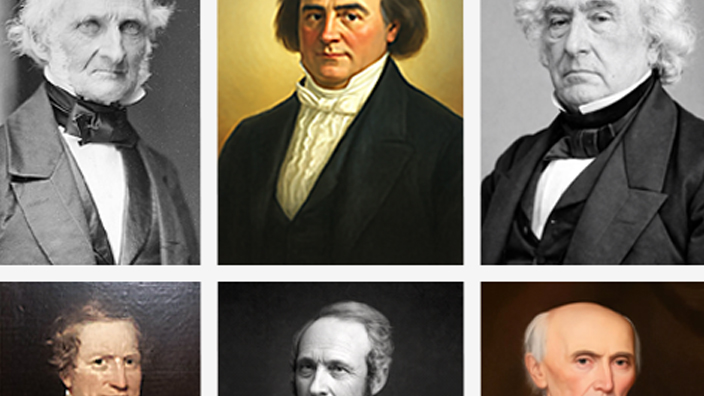
Nathan Kelsey Hall, who served from 1850-1852 under President Millard Fillmore, was known as a man of great integrity who railed against the misuse of franking privileges, called for tough penalties for equipment theft, and was scrupulously even-handed about awarding contracts.
The Hall bio joins several other biographies of former postmasters general recently added to usps.com: Francis Granger, Charles Wickliffe, Cave Johnson and Jacob Collamer.
Link also shared reminders on the proper disposal of fire extinguishers; the ethics rules surrounding fundraising; the Aug. 5 deadline for ordering semipostal T-shirts from Tee Luv; and the new “Mailin’ It!” podcast, which explains Free Matter for the Blind, a partnership between USPS and the National Library Service for the Blind and Print Disabled.
In the latest cautionary tale shared by the USPS Office of Inspector General, we reported on a retail clerk who set aside packages of cocaine that came in the mailstream and was paid for passing them on to an associate. The clerk was sentenced to 2 ½ years in federal prison.
And in an article adapted from The Eagle magazine, we spotlighted Stacy Douglas, a Sioux Falls, SD, letter carrier who volunteers with Sleep in Heavenly Peace. The charitable group builds, assembles and delivers beds, sheets and pillows for children in need.
“The effect it has on these kids is remarkable,” said Douglas, who’s heard of children sleeping on the floor, air mattresses, pool floats — even a bathtub — before the group was able to help.
Finally, “Heroes” told the story of Charles Koontz, a Lexington, NC, letter carrier who heard someone calling for help while delivering his route.
He ran to the customer, who was standing next to a car. A car seat strap had gotten entangled around her distraught grandson’s neck.
After calling 911, the USPS employee attempted to cut the strap with a knife, which was unsuccessful, but was able to free the child after obtaining a pair of scissors.
He waited with the family until paramedics arrived. The child was not injured.
Email us your feedback. Your comments could be included in our “Mail” column.
USPS historian appears on History Channel podcast
A new episode of the “History This Week” podcast from History Channel tells the story of how and why the Second Continental Congress appointed Benjamin Franklin postmaster general on July 26, 1775.
The podcast features USPS Historian Steve Kochersperger along with Dan Piazza and Lynn Heidelbaugh of the Smithsonian National Postal Museum.
The “Ben Franklin Gets Fired” episode was released on July 20 and is available on Substack and most podcast platforms.
View past printouts
Printout details
What's included
-
History
This Post Office invites visitors to step back in time
-
Heroes
He freed a child from a car seat
The customer’s grandson had become entangled in a shoulder belt
-
Week in Review
Here’s what Link covered July 19-25
A 19th-century PMG and a South Dakota volunteer made news
-
Brief
USPS historian appears on History Channel podcast