Thursday, October 2, 2025

He showed us that ‘true greatness lies in service to others’
USPS dedicates stamp honoring former President Jimmy Carter
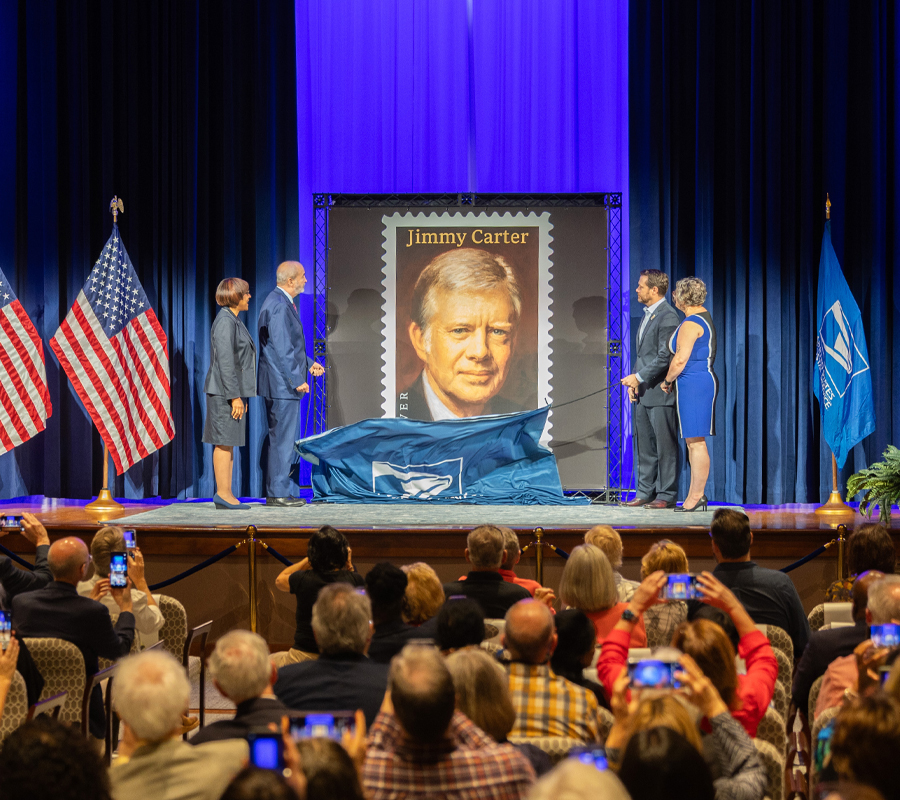
The Postal Service dedicated its stamp honoring Jimmy Carter on Oct. 1, where the 39th president was hailed for his lifetime of extraordinary service.
Carter (1924-2024) guided the nation through an energy crisis, economic struggles and international tensions. After his presidency, he worked to improve the lives of people around the world.
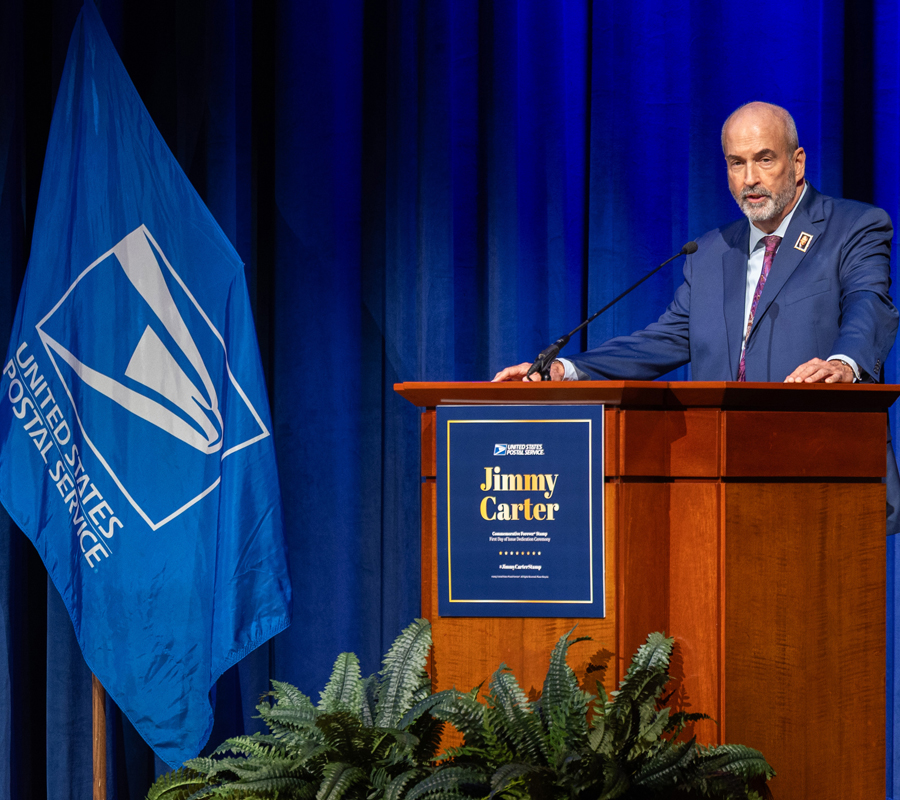
“President Carter’s legacy challenges us to think differently about success and leadership. In a world that often measures worth by wealth and power, he reminded us that true greatness lies in service to others,” Thomas Marshall, the Postal Service’s general counsel, said during the stamp dedication ceremony in Atlanta.
Carter was born in Plains, GA — a town of just 600 people — the start of an unconventional path to the presidency. A graduate of the U.S. Naval Academy who served on nuclear submarines, he returned to Georgia to take over the family farm after his father’s death.
From local politics to the Georgia governor’s mansion, and then to the White House in 1977, Carter brought with him an outsider’s perspective and a commitment to doing what he believed was right, regardless of the political cost.
His administration also achieved many milestones, including the Camp David Accords, which led to a peace treaty between Egypt and Israel, and the establishment of diplomatic relations with China, which ended decades of isolation.
Carter also made human rights a central focus of U.S. foreign policy, saying: “America did not invent human rights. In a very real sense, it’s the other way around. Human rights invented America.”
Perhaps the most remarkable chapter of Carter’s life began after he left the White House.
“Rather than retreating to a comfortable retirement, he and his wife, Rosalynn, embarked on what many consider to be the most consequential post-presidency in American history,” Marshall said.
Through the Carter Center, founded in 1982, the former president worked tirelessly to advance human rights, monitor elections and eradicate diseases. For decades, well into his 90s, he continued building homes with Habitat for Humanity, hammer in hand, side by side with volunteers.
“He showed us true leadership means getting your hands dirty in the service of others, and it spoke volumes about his values and priorities,” Marshall said.
The Norwegian Nobel Committee awarded Carter the Nobel Peace Prize in 2002 for his decades of work promoting peace, democracy and human rights.
Joining Marshall for the ceremony were Meredith R. Evans, director of the Jimmy Carter Presidential Library and Museum; Beth Davis, chief operating officer of the Carter Center; grandson Jason J. Carter, chair of the Carter Center’s board of trustees; and Crystal Edmonson, broadcast editor of the Atlanta Business Chronicle, who served as emcee.
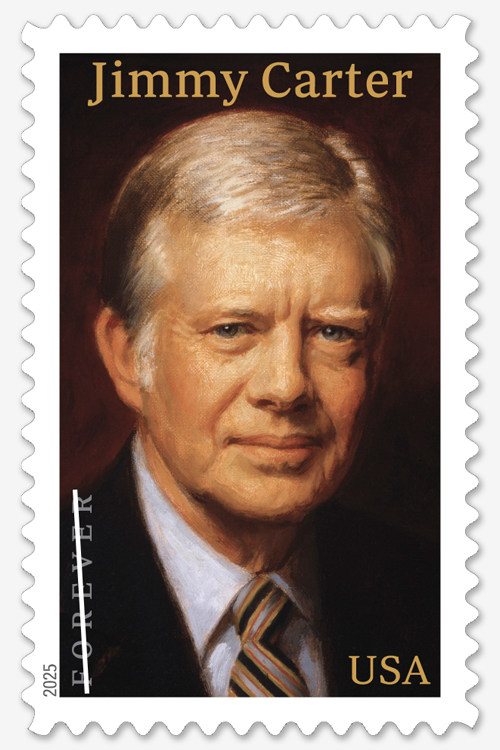
Ethel Kessler, an art director for USPS, designed the stamp featuring a 1982 oil-on-linen painting by Herbert Abrams, who used it to prepare for the official White House portrait.
The Forever stamp is available in panes of 20 at Post Offices and on usps.com.
Marshall said that in Carter’s life, “we see a blueprint for how to live with purpose, how to lead with integrity and how to make a difference that extends far beyond our own lives. He showed us that the presidency might be the highest office in the land, but the highest calling is simply to serve others with compassion and humility.”
Email us your feedback. Your comments could be included in our “Mail” column.
Leading USPS into the future
A special episode of ‘Mailin’ It!’ features the PMG
Postmaster General David Steiner appears on the latest episode of “Mailin’ It!,” the USPS podcast.
He outlines his vision for leading the Postal Service through a period of transformation and discusses the challenges and opportunities facing the organization.
The 32-minute episode was released Sept. 30 and is available on Link and other postal websites, as well as most podcast platforms.

October is National Disability Employment Awareness Month
The annual observance is marking its 80th anniversary
In October, the Postal Service will observe National Disability Employment Awareness Month, which is marking its 80th anniversary this year.
The annual commemoration began in 1945 as a weeklong recognition of workers with disabilities and expanded to a full month in 1988.
The U.S. Department of Labor’s Office of Disability Employment Policy promotes the observance, whose theme this year will be “Celebrating Value and Talent.”
“Celebrating America means celebrating the value and talent that all Americans — including people with disabilities — add to our nation’s workplaces and communities,” said Labor Secretary Lori Chavez-DeRemer. “As we approach the 80th anniversary of National Disability Employment Awareness Month, the Department of Labor remains committed to ensuring all people have the opportunity to find meaningful work.”
The Postal Service employs over 42,000 individuals who identify as having a disability.
Employees with a disability can self-identify, or update a disability already on file, by completing PS Form 2489, Self-Identification of a Physical or Mental Disability.
Information obtained from this form is kept confidential and serves as a tool to improve the recruitment, hiring, advancement and retention of individuals with disabilities. PS Form 2489 is not a request for reasonable accommodation.
The Disabilities & Reasonable Accommodations page on the MyHR website has more information about reasonable accommodation at USPS, while the Department of Labor’s website has an overview of National Disability Employment Awareness Month.
Don’t throw away used light bulbs
In most cases, employees and contractors should recycle them instead
The Postal Service is reminding employees and contractors not to toss away light bulbs when they are no longer usable.
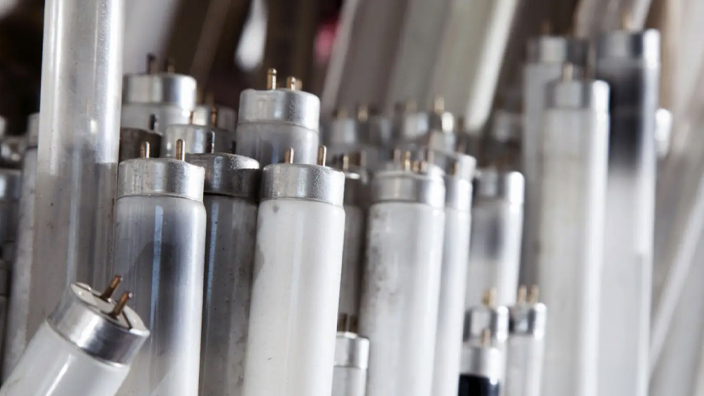
Most light bulbs — including fluorescent, compact fluorescent, high-intensity discharge (HID), light-emitting diode (LED), neon and ultraviolet lamps — contain hazardous materials such as mercury, a toxic metal.
USPS considers these items universal waste that must be recycled. Facilities must also ensure that employees who manage or handle waste bulbs are properly trained.
To recycle universal waste bulbs, facilities must:
• Store broken or inoperable bulbs in closed containers that are clearly labeled;
• Arrange for off-site recycling within 365 days of the original waste-generation date;
• Recycle waste bulbs using Cleanlites Recycling, the organization’s national service provider; and
• Use mailback recycling containers or arrange for on-site pickup. Both options are available through Cleanlites in eBuy Plus, the USPS online purchasing platform.
Incandescent and halogen bulbs can be disposed of in the trash or dumpster since they are typically nonhazardous and don’t contain mercury or other toxic metals.
The Waste Light Bulbs and Lamps Blue page has additional information.
Atlantic Area, Michigan 2 lead in scanning
A snapshot of Postal Service scanning data shows the national rating was 97.02 percent during the week ending Sept. 26, up 0.41 percent from one week earlier.
The data was collected Oct. 1.
Atlantic led the four areas with a rating of 97.15 percent, while Southern ranked last with a 96.77 percent rating.
Among the 50 districts, Michigan 2, part of Central Area, ranked first with a 98.36 percent rating, while Illinois 2, also part of Central Area, ranked last with a 94.04 percent rating.
Scanning data allows customers to track their mail and packages, which helps USPS deliver excellent service, boost loyalty and drive revenue.
To see the latest data, go to the Informed Visibility website and select “Customer Experience,” followed by “DES 2 Scan Performance.” Postal Service employees must request Informed Visibility access through eAccess.
View past printouts
Printout details
What's included
-
He showed us that ‘true greatness lies in service to others’
-
Leading USPS into the future
A special episode of ‘Mailin’ It!’ features the PMG
-
October is National Disability Employment Awareness Month
-
Don’t throw away used light bulbs
In most cases, employees and contractors should recycle them instead
-
Brief
Atlantic Area, Michigan 2 lead in scanning