Tuesday, August 25, 2026
USPS to honor Linda McCartney with five stamps
She was a photographer, writer, musician and activist
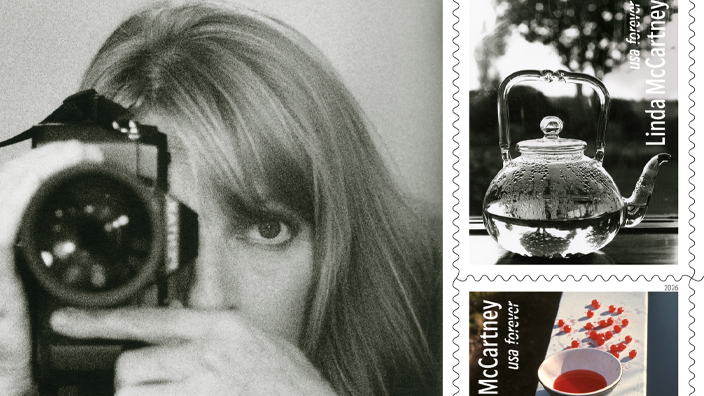
The Postal Service will honor the art and life of photographer, author, musician and animal rights activist Linda McCartney with five stamps featuring images of her work.
The stamps will be released on Friday, Sept. 25, at the Museum of Modern Art in New York City.
Born Linda Eastman in Scarsdale, NY, in 1941, she rose to prominence in 1966 after photographing the Rolling Stones while working as an editorial receptionist at Town and Country magazine. The editors were so impressed with her work that they turned the images into a feature.
It became the first of many magazine spreads, with Eastman becoming known as a chronicler of 1960s music culture. A 1968 portrait of Eric Clapton made her the first female photographer whose work appeared on the cover of Rolling Stone magazine.
She met future husband — Paul McCartney, bass guitarist for British rock band the Beatles — while on assignment in London in 1967. They married two years later.
Her photographs have been exhibited throughout the United States as well as at the Royal Photographic Society and the Victoria and Albert Museum in the United Kingdom.
She later became a founding member of the pop-rock band Wings and an influential figure in the vegetarianism movement.
Linda McCartney died in 1998 at age 56 in Tucson, AZ.
The stamps and stamp pane were designed by Derry Noyes, an art director with USPS, using five McCartney photographs.
The Forever stamps will be sold in panes of 20 and will be available at Post Offices and on usps.com.
Email us your feedback. Your comments could be included in our “Mail” column.
History
Palo Alto Post Office’s design tells a story
The architect had to name-drop the first lady to get his plans approved
Palo Alto, CA, traces its founding to a mission church established by a Roman Catholic priest in 1777 when the area was part of the Spanish Empire.
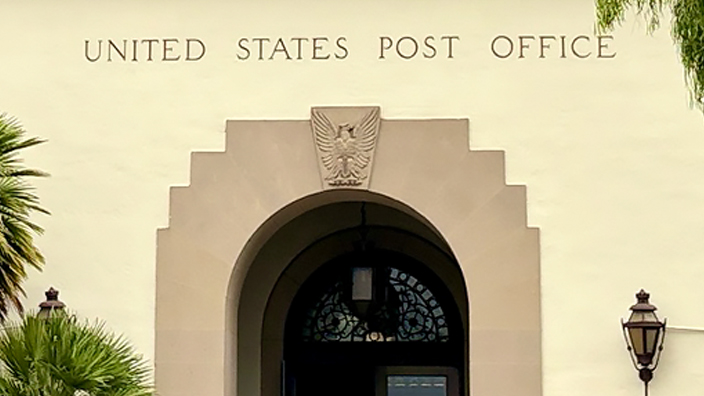
The city’s Hamilton Station Post Office — built more than 150 years later in the Spanish Colonial Revival style — blends in well with neighboring buildings that have Spanish and Mediterranean-inspired design cues, such as tile roofs, rounded arches and wrought-iron grilles.
But it took the borrowed clout of then-first lady Lou Hoover to make that happen.
In 1932, the U.S. Department of the Treasury — which was responsible for designing federal buildings at that time — hired local architect Birge Clark to design Palo Alto’s first Post Office.
His plans leaned heavily on the Spanish Colonial Revival style — also known as Spanish Mediterranean Revival, Spanish Eclectic, California Colonial or Mission Revival — which is also used at Palo Alto’s Stanford University, Hoover’s alma mater.
Clark’s proposal called for stucco walls, colonial arcades and a clay tile roof instead of the more sober, institutional look that was standard for federal buildings at the time.
According to Noel Roman, the Postal Service’s historical preservation architect, Clark was met with opposition when he brought his plans to Washington, DC, for approval.
“Louis Simon was the supervising architect for Treasury at the time, and he was not at all impressed with Clark’s intentions to deviate from the more standard federal designs of the day,” Roman said.
An article in Northern California Homes & Gardens magazine published in May 1989 recounts Clark telling the unimpressed Simon, “Well, I am sorry, but when I had lunch at the White House, Mrs. Hoover told me she hoped I would work in an arcade and a tile roof.”
The next day, Simon told Clark, “You may proceed with the sketches as submitted.”
The Post Office, which opened in 1933, cost $406,000 to build and was constructed with sandstone from the same San Jose quarry that supplied material for buildings on Stanford’s campus.
“This was the start of a new era of asking local architects to design Post Offices for their people, in cities they already knew,” Roman said.
Other California Post Offices ended up being built in the Spanish Colonial Revival style during this period: San Bernadino and Santa Ana in 1931, and Redlands in 1934.
“It’s still surprising and amazing that they were able to build in this style,” Roman said. “It was very different than what was being designed in California at the time, especially the Neoclassical or Art Deco styling that was so embraced by Hollywood.”
The building was added to the National Register of Historic Places in 1981.
Roman said Post Offices often reflect the communities they serve through their building design.
“You’ll see Pueblo style in Arizona and Colonial style in New England.”
Regional styles are also evident in the artwork in many Post Offices — including 1,400 murals and sculptures, mostly created by local artists.
“You can step into a Post Office today and look up and see the same mural that your grandparents saw,” he said. “This binds people together and connects generations, and it represents the best of the community and its talent.”
The “History” column appears occasionally in Link.
These postcards take global mail to the max
Special Postcrossing products promote themed mailings
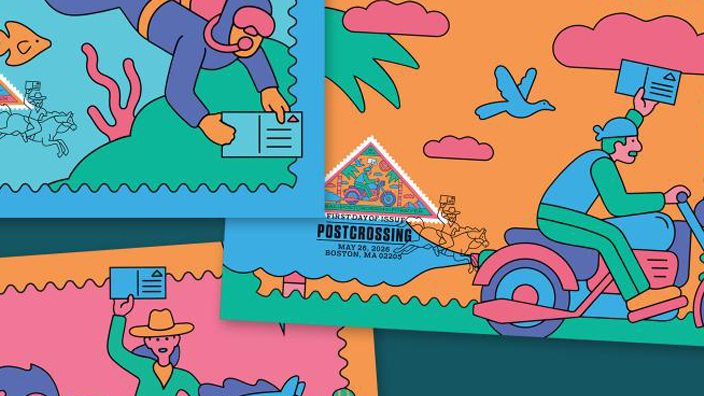
The Postal Service recently issued a set of four stamps celebrating Postcrossing, a global project that enables its participants to send and receive postcards from random people all over the world.
Since its launch in 2005, more than 800,000 people in more than 200 countries and territories have mailed more than 87 million postcards. However, there is one aspect of the hobby that often puzzles newcomers: the “maxicard.”
Maxicards are postcards that combine stamps, postcards and imagery in especially thoughtful or creative ways.
The stamp on a maxicard is placed on the image side of the postcard — not the address or message side — and is postmarked on the image side as well.
When the postcard artwork, postmark and stamp all share a thematic connection, collectors call this “maximum concordance,” the term that gives maxicards their name.
Here is an example of how to create a maxicard:
• Take one of the Battlefields of the American Revolution stamps from 2025, which displays a photograph of the Old Barracks Museum in New Jersey, where Hessian and British soldiers were housed before the Battle of Trenton;
• Place that stamp on the image side of a postcard of the barracks or George Washington’s famous Delaware River crossing prior to the fight; and
• Then get the card postmarked with a relevant place and date, such as a Post Office in Trenton on the Dec. 26 anniversary of the battle.
Along with its Postcrossing stamps, the Postal Service also released a set of four maxicards. Each card is affixed with a stamp on the front and cancelled with the Postcrossing first-day-of-issue postmark.
Email us your feedback. Your comments could be included in our “Mail” column.
Have a mobile device? Check in once a week
The Postal Service is reminding employees and contractors with USPS-issued smartphones and tablets to do a manual check-in on the device at least once a week.
The check-ins enable app updates, installations and configurations; compliance and status reporting; general communications; and vulnerability fixes.
To check in, Android and iOS device users will need to open the Ivanti Go app; MacBook users will need to use the Ivanti Mobile@Work app.
The USPS ServiceNow website has more information. A video is also available on BlueTube. Information for MacBook users is available on SharePoint.