Palo Alto, CA, traces its founding to a mission church established by a Roman Catholic priest in 1777 when the area was part of the Spanish Empire.
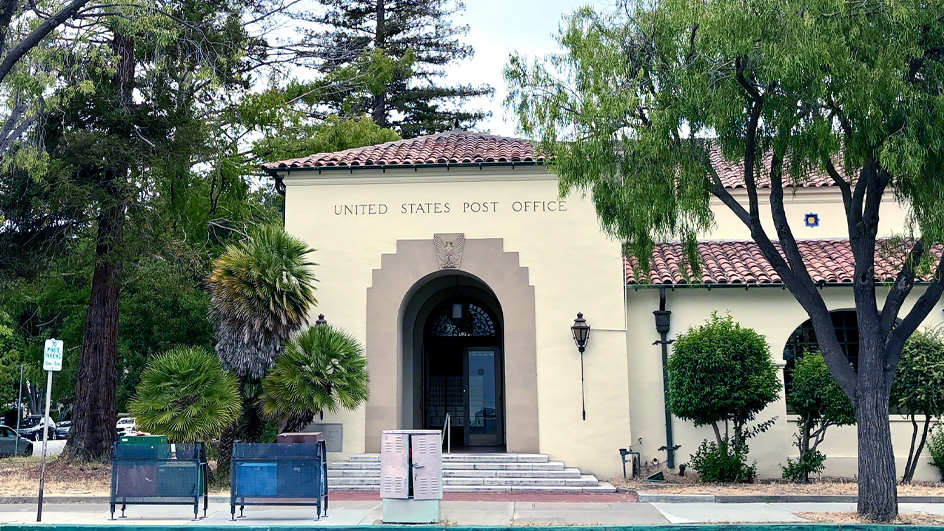
The city’s Hamilton Station Post Office — built more than 150 years later in the Spanish Colonial Revival style — blends in well with neighboring buildings that have Spanish and Mediterranean-inspired design cues, such as tile roofs, rounded arches and wrought-iron grilles.
But it took the borrowed clout of then-first lady Lou Hoover to make that happen.
In 1932, the U.S. Department of the Treasury — which was responsible for designing federal buildings at that time — hired local architect Birge Clark to design Palo Alto’s first Post Office.
His plans leaned heavily on the Spanish Colonial Revival style — also known as Spanish Mediterranean Revival, Spanish Eclectic, California Colonial or Mission Revival — which is also used at Palo Alto’s Stanford University, Hoover’s alma mater.
Clark’s proposal called for stucco walls, colonial arcades and a clay tile roof instead of the more sober, institutional look that was standard for federal buildings at the time.
According to Noel Roman, the Postal Service’s historical preservation architect, Clark was met with opposition when he brought his plans to Washington, DC, for approval.
“Louis Simon was the supervising architect for Treasury at the time, and he was not at all impressed with Clark’s intentions to deviate from the more standard federal designs of the day,” Roman said.
An article in Northern California Homes & Gardens magazine published in May 1989 recounts Clark telling the unimpressed Simon, “Well, I am sorry, but when I had lunch at the White House, Mrs. Hoover told me she hoped I would work in an arcade and a tile roof.”
The next day, Simon told Clark, “You may proceed with the sketches as submitted.”
The Post Office, which opened in 1933, cost $406,000 to build and was constructed with sandstone from the same San Jose quarry that supplied material for buildings on Stanford’s campus.
“This was the start of a new era of asking local architects to design Post Offices for their people, in cities they already knew,” Roman said.
Other California Post Offices ended up being built in the Spanish Colonial Revival style during this period: San Bernadino and Santa Ana in 1931, and Redlands in 1934.
“It’s still surprising and amazing that they were able to build in this style,” Roman said. “It was very different than what was being designed in California at the time, especially the Neoclassical or Art Deco styling that was so embraced by Hollywood.”
The building was added to the National Register of Historic Places in 1981.
Roman said Post Offices often reflect the communities they serve through their building design.
“You’ll see Pueblo style in Arizona and Colonial style in New England.”
Regional styles are also evident in the artwork in many Post Offices — including 1,400 murals and sculptures, mostly created by local artists.
“You can step into a Post Office today and look up and see the same mural that your grandparents saw,” he said. “This binds people together and connects generations, and it represents the best of the community and its talent.”
The “History” column appears occasionally in Link.