On July 26, 1975, the public was invited to preview the opening of the B. Free Franklin Post Office in Philadelphia.
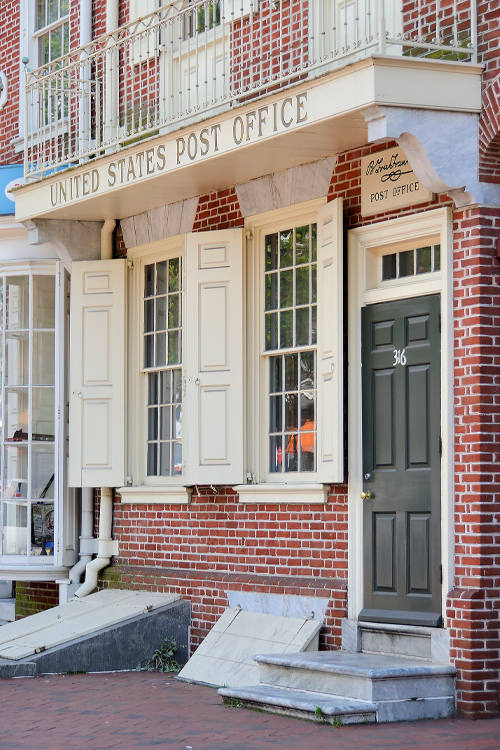
The new Post Office celebrated the 200th anniversary of the Postal Service and the date in 1775 when the Second Continental Congress appointed Benjamin Franklin postmaster general. In addition to commemorating the Founding Father’s postal role, the branch was established to honor the nation’s bicentennial the following year.
Both the selection of the Post Office’s site and its “B. Free Franklin” moniker are significant.
The Post Office building, a three-story rowhouse located at 316 Market St. in the heart of the City of Brotherly Love, was owned and occupied by Franklin from 1737 to 1753.
The building itself did not function as a Post Office during Franklin’s time. However, it was refurbished to reflect the Colonial era in appearance, and its employees dressed in period costume.
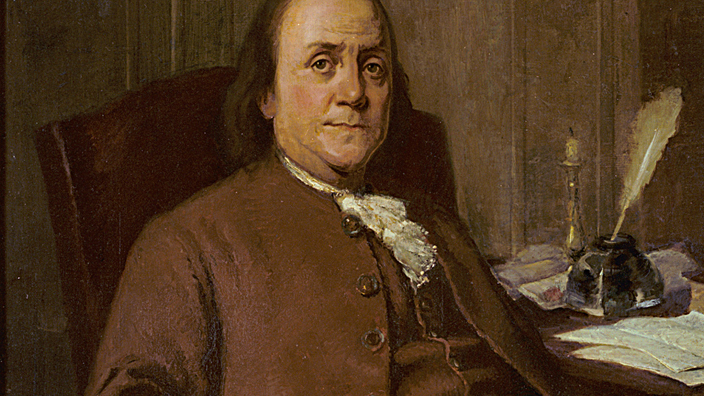
Franklin was first appointed postmaster of Philadelphia in 1737 for the British Crown and later became co-postmaster general with William Hunter of the British North American colonies. He served in that position from 1757-1774 and is credited with increasing the efficiency of the post through improvements in bookkeeping and delivery routes.
Franklin was appointed postmaster general under the authority of the Second Continental Congress and served from 1775-1776.
When he became a postmaster, Franklin used the “B. Free Franklin” signature on letters he sent. It is generally assumed his use of the word “Free” between his first initial and surname was in protest of British rule and a patriotic reference to the American struggle for freedom. However, according to USPS Historian Stephen Kochersperger, as postmaster Franklin was allowed to send his letters without paying postage — a practice afforded certain government officials called “franking.”
“Franked letters had to include the word FREE and the signature of the sender. Ben cleverly combined both items into B Free Franklin, which has retroactively been interpreted as a political protest against British rule. This claim doesn’t hold up under scrutiny — Franklin was a loyal officer of the Crown until he was fired in 1774. He never opposed British rule before that,” he said.
The B. Free Franklin Post Office opened for two days in 1975 — July 26-27 — with Postal Service and National Park Service officials taking part in a ceremony. The site then closed for construction of the attached Franklin Court Complex to be completed.
The branch reopened on Sept. 3, 1975, and includes a museum of postal history. It is a partner site of Independence National Historical Park, which the National Park Service maintains.
Today, if customers want to mail a postcard or letter from this location, postal employees there will hand cancel the stamp using Franklin’s “B. Free Franklin” signature postmark.
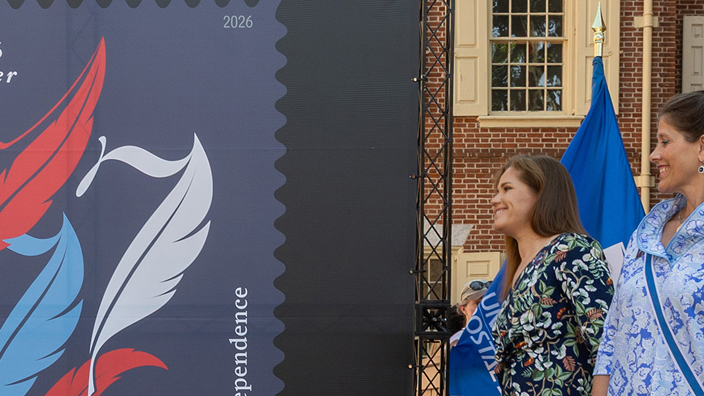
The B. Free Franklin Post Office most recently served as the site of the Declaration of Independence stamp dedication on July 4 in celebration of the U.S. semiquincentennial.
The “History” column appears occasionally in Link.