Thursday, January 8, 2026

There’s a new Thrift Savings Plan benefit
Participants will be allowed to convert to Roth funds
The Thrift Savings Plan will allow participants to convert traditional funds to Roth funds within their TSP account beginning Wednesday, Jan. 28.
This is known as a Roth in-plan conversion.
Traditional retirement contributions are those that are taken from employee paychecks on a pretax basis, which can lower your taxable income for the year. You are taxed later when the funds are withdrawn.
Roth retirement contributions are considered taxable in the year they are made and are taxed before they are deposited into your TSP account. However, qualified withdrawals from Roth accounts are tax-free. Unlike traditional funds, Roth funds are not subject to Internal Revenue Service rules on required minimum distributions.
If you’re considering doing a Roth in-plan conversion, the Postal Service strongly encourages you to consult a tax advisor to start planning how it would affect your taxable income and estimate how much you may need to pay in taxes.
When you convert pre-tax money from your traditional TSP balance, your Roth in-plan conversion amount will become part of your taxable income for the year. This means that you’ll pay income tax on the conversion amount based on your income tax rate.
You must pay the income tax on the conversion amount using personal funds from another source, such as a savings account. You cannot use part of the conversion amount in your TSP account to pay taxes.
The TSP website has more information about traditional and Roth IRAs.
Employees with questions can email the TSP or call 877-968-3778, Monday-Friday from 7 a.m. to 9 p.m. Eastern.
Participants will need their six-digit TSP PIN to access their account.
For telecommunications assistance, dial 711 from any phone.
Employees with questions can also email the USPS Benefits and Wellness team.
Off the Clock
Bluebirds bring her happiness
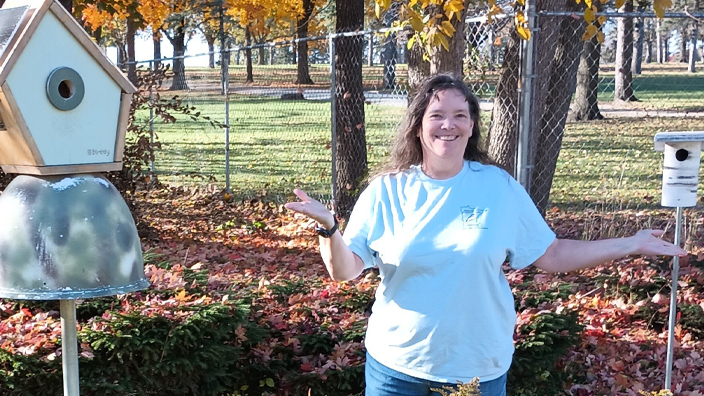
This USPS employee monitors nest boxes as a citizen scientist
My name is Stacy Shuda and I’m a solutions architect for the Postal Service’s architecture, strategy and innovation group, which is part of the chief information officer’s organization in Eagan, MN.
When I’m not at work you might find me monitoring bluebird nest boxes as a citizen scientist, providing data to groups such as the Bluebird Program of Minnesota, the North American Bluebird Society and the Cornell Lab of Ornithology.
In 2017, I began monitoring the birds in my back yard to provide data for FeederWatch, an app that collects data on birds.
During the pandemic, I saw a new neighbor checking on a nest box he set up in his yard and he told me about bluebird trail monitoring.
Conservationists began setting up nest boxes far and wide several decades ago to counteract habitat loss for secondary cavity nesters such as bluebirds. Careful monitoring over time has shown that birds thrive better in some years than others. Badly timed or excessively harsh winter storms, for example, can have a detrimental effect on populations.
My husband and I were delighted to take over trails from monitors who were getting too old to do the once- or twice-weekly checks. Some of our boxes are out on country roads, and some are near open lawns, such as golf courses or athletic fields. We report on the number of nesting attempts, eggs laid, eggs hatched and fledglings leaving the nest.
The bluebirds stand on top of the boxes scanning for insects in the grass to feed to their chicks. Eggs take about two weeks to hatch, and within the next three weeks, the babies grow almost as large as their parents.
In four seasons, we have recorded almost 300 fledglings on our relatively small trail of around 20 nesting sites.
I’ve learned a few things in my time as a monitor. For example, while pesticides may be an effective tool for humans, insects are a crucial source of protein for baby birds. Fewer insects can mean fewer birds. And invasive species can out-compete native bluebirds by destroying eggs, hatchlings and even adult females.
I’ve recently begun to set up educational tables at community events to share my enthusiasm for birds. Birding is my favorite way to indulge my passion for nature, and it helps balance all the time I work indoors at a computer.
“Off the Clock,” a column on Postal Service employees and their after-hours pursuits, appears regularly in Link.

USPS facilities must follow the rules on storing these chemicals
Deicing and anti-skid products may be regulated under federal, state and local laws
The Postal Service wants to remind facilities that store large quantities of deicing and anti-skid chemical products to follow the rules for proper storage.
These products include sodium chloride or rock salt, calcium and magnesium chloride, calcium magnesium acetate and sand.
Deicing and anti-skid products may be regulated under federal, state and local laws.
Regulations could include mandatory chemical reporting, restrictions on the amount stored, permitting and requirements for on-site storage areas.
Additionally, under the organization’s zero discharge policy, facilities that store these products must keep them under an awning, shed, tarp or similar shelter.
Facilities should not purchase or store more than 10,000 pounds of deicing and anti-skid products in a single location, unless absolutely necessary.
The De-Icing and Anti-Skid Product Storage Environmental Compliance Bulletin, available on the Environmental Affairs Blue page, has more information.
Employees who have questions should consult their region’s designated USPS environmental specialist.
January 15, 2026
Datebook
Muhammad Ali stamp ceremony
The Postal Service will dedicate its Muhammad Ali stamp on Thursday, Jan. 15, in Louisville, KY.
The event will be held at noon Eastern at the University of Louisville’s L&N Federal Credit Union Stadium, located at 2550 S. Floyd St.
Attendees are encouraged to RSVP online.
Central Area, Minnesota-North Dakota District lead in scanning
A snapshot of Postal Service scanning data shows the national rating was 97.06 percent during the week ending Jan. 2, up 0.08 percent from one week earlier.
The data was collected Jan. 7.
Central led the four areas with a rating of 97.48 percent, while Atlantic ranked last with a 96.76 percent rating.
Among the 50 districts, Minnesota-North Dakota, part of Central Area, ranked first with a 98.45 percent rating, while Alaska, part of WestPac Area, ranked last with a 93.54 percent rating.
Scanning data allows customers to track their mail and packages, which helps USPS deliver excellent service, boost loyalty and drive revenue.
To see the latest data, go to the Informed Visibility website and select “Customer Experience,” followed by “DES 2 Scan Performance.” Postal Service employees must request Informed Visibility access through eAccess.
View past printouts
Printout details
What's included
-
There’s a new Thrift Savings Plan benefit
Participants will be allowed to convert to Roth funds
-
Off the Clock
Bluebirds bring her happiness
This USPS employee monitors nest boxes as a citizen scientist
-
USPS facilities must follow the rules on storing these chemicals
-
January15Datebook
Muhammad Ali stamp ceremony
-
Brief
Central Area, Minnesota-North Dakota District lead in scanning