Tuesday, December 30, 2025
USPS begins penny-rounding policy
This only applies to cash transactions when the coin is unavailable
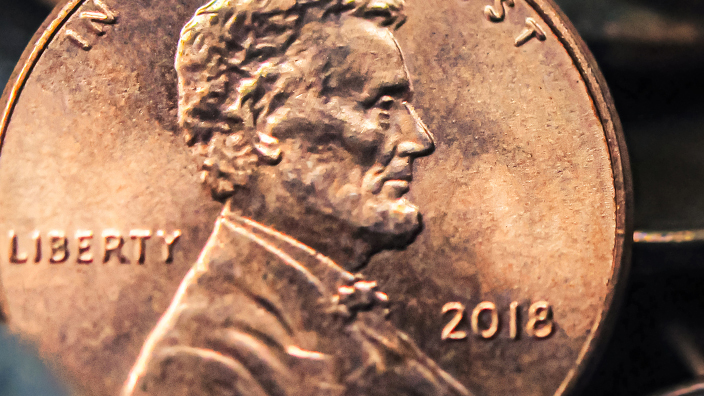
Because pennies are no longer produced by the U.S. Mint, the Postal Service is rounding to the nearest nickel on change due the customer for cash transactions when pennies are unavailable.
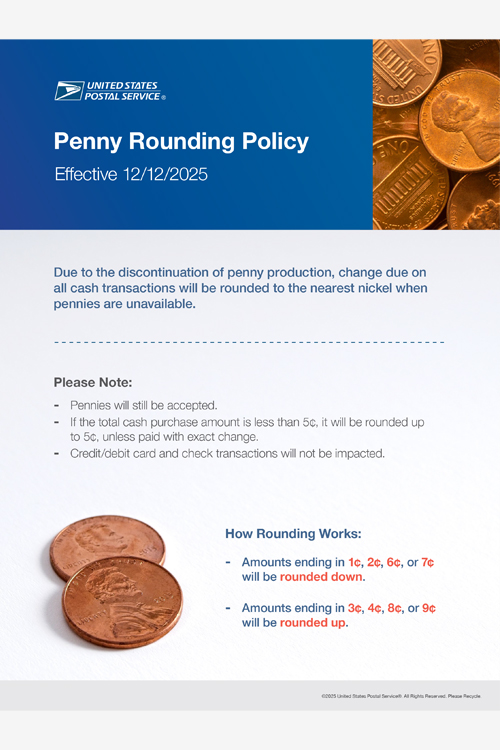
Change due to the customer ending in 1, 2, 6 or 7 cents will be rounded down. Amounts ending in 3, 4, 8 or 9 cents will be rounded up.
If the total cash visit amount is less than 5 cents, the purchase amount will be rounded up to 5 cents, unless paid with exact change.
Pennies are legal tender and are still accepted as payment.
This new policy took effect Dec. 12.
The rounding rules do not apply to credit/debit card or check transactions.
The U.S. Mint ceased production of pennies, which were introduced in 1793, on Nov. 12.

On the Job
They keep the Postal Service humming
These employees made important contributions this year
Throughout 2025, Link’s “On the Job” column spotlighted Postal Service employees and their contributions to the organization.
Kevin Rayburn, an attorney in Washington, DC, has a particularly important job: Through his work with the USPS Ethics Office, he helps uphold the public’s trust in the Postal Service.
“A big element of what our team does is to make sure that we can continue an ethical mindset throughout our organization, in all operational areas,” he said.
Two other Washington, DC, employees — Ashley Motta, a congressional liaison, and Michael Marazzi, a correspondence analyst — help ensure the Postal Service has strong relationships with government entities and their constituents.
“USPS is many people’s most frequent point of connection with the federal government, and I think it’s important they see what’s possible when the government works to serve people and communities,” Marazzi said.
Marty Mieras, the organization’s military programs specialist, builds relationships with military and veterans organizations to recruit top talent to join USPS, and he keeps current veteran employees up to date on information that is important to them.
“I still see myself as a sergeant major keeping my troops informed,” he said.
Two customer services supervisors — Chloe Bickman, who works in New Orleans, and Eleanor Gary, who works in West Los Angeles — appreciate their ability to interact with the public.
“Every day I learn something new. USPS changes day to day, hour by hour. It’s fast-paced and keeps me on my toes,” Bickman said.
Angela Dyer, commerce applications senior director in Washington, DC, is also focused on helping the Postal Service prosper.
“We are expanding access to our products and services, which ultimately drives business growth,” she said.
Similarly, as the Postal Service’s domestic package pricing director, Lisa Arcari keeps up with the shipping market and trends so she can competitively price USPS products amidst a constantly changing landscape.
“I must stay aware of pricing as well as perceptions of our service. The better value we have, the better competitive position we have,” she said.
Elsewhere, Lou DiRienzo, a deputy chief postal inspector in Washington, DC, and Christian Santiago, a driving safety instructor in Queens, NY, each focus on keeping employees safe.
“What I like about teaching is I get to pass along my own knowledge and experience. What I learned got me far, and now I help others do the same,” Santiago said.
For other employees, such as Derrick Milling, an IT client support manager in Washington, DC, a Postal Service career means life is never boring.
“There’s always something to do. There’s always something to monitor. There’s always a new project. I love it,” he said.
Check out the “On the Job” archive for more stories about Postal Service employees and their contributions to the organization.







A new year is almost here
Around the world, Jan. 1 is a time for reflection and renewal
New Year’s Day, a time of reflection and renewal for people around the world, is Thursday, Jan. 1.
The celebration of a new year is a custom that can be traced to ancient civilizations, although the date often varied. The Julian calendar established Jan. 1 as the start of the new year, a practice that continued when the Gregorian calendar was adopted in 1582.
Through the centuries, New Year’s Day became a time for social gatherings and feasts, although it didn’t become a federal holiday in the United States until 1870.
Today, the holiday is marked by the Times Square ball drop in New York City, a tradition that began in 1907; parades; football games; and the making of resolutions.
The Postal Service released a Baby New Year stamp in 1999 to mark the arrival of the new century, and the organization has a long history of releasing stamps to celebrate the Lunar New Year, an important holiday in many Asian communities. Most Lunar New Years are celebrated in late January or early February.
Mail
Good as Goldman
Readers were inspired by the postmaster who grew USPS Operation Santa
View past printouts
Printout details
What's included
-
USPS begins penny-rounding policy
This only applies to cash transactions when the coin is unavailable
-
On the Job
They keep the Postal Service humming
These employees made important contributions this year
-
A new year is almost here
Around the world, Jan. 1 is a time for reflection and renewal
-
Mail
Featured reader quote
“Link does a fantastic job of putting a personal perspective on the Postal Service, and I loved ‘His big heart grew USPS Operation Santa,’ about former New York City postmaster...”
— Vicki Lynn, Gastonia, NC