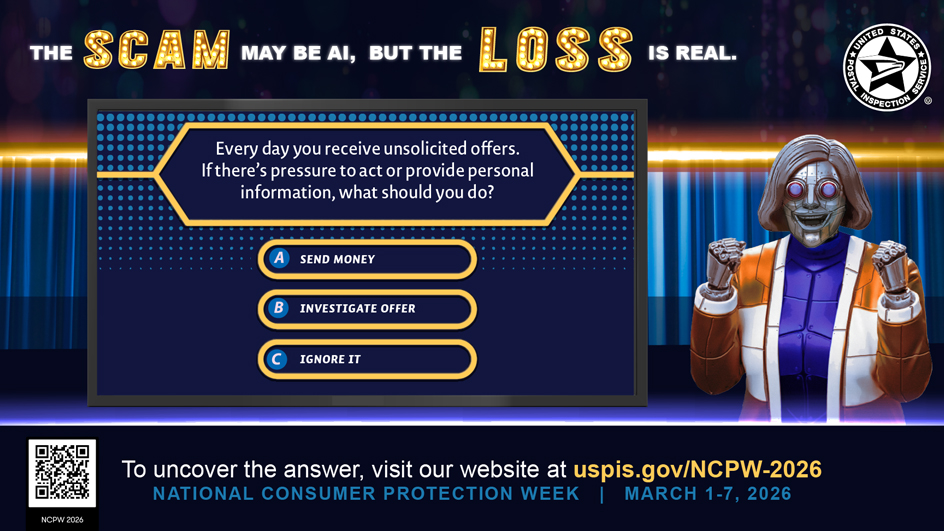
The Postal Inspection Service is reminding employees and customers during National Consumer Protection Week March 1-7 to beware of artificial intelligence scams.
Scammers are now using artificial intelligence, or AI, tools to make their schemes appear more believable.
AI can generate lookalike photos, clone voices and compose wording in texts and emails to build trust with a victim. This can result in romance scams, investment scams, illegitimate tech support calls and fake emergency requests from friends and family.
Here are characteristics of AI scams:
• The “person” contacting you has an inconsistent, newly created profile with very few social media friends. The comments don’t seem natural, and the images don’t match the profile details.
• The website is not secure, and it requests login information.
• An email address doesn’t match the website domain — such as john.doe@usps.us.com.
• Images or screenshots seem fabricated.
• You are asked to communicate through an encrypted messaging app, such as WhatsApp or Telegram, or a separate, private email address — all of which can be a scammer’s way to bypass a social media platform’s security protocols.
• The speaker’s movements are irregular, the lip sync timing is off, the lighting is unnatural or the voice does not match the purported person being represented.
• The offer pitched to you involves guaranteed high returns, pressure to recruit others or exclusive private opportunities.
If you think you have been the victim of an AI scam, take immediate action:
• Stop communicating with the alleged scammer and save all messages and transaction records.
• Contact the bank or payment provider to trace or stop all fund transfers.
• Report the scam to local police if you were threatened or lost a significant sum of money. If you used cryptocurrency, tracing will be difficult, but early reporting increases the chance of recovering your funds.
• Change your passwords and enable multifactor authentication if you shared login information.
• Initiate fraud alerts and enact a credit freeze with the three major credit reporting bureaus if you shared sensitive financial data.
If the scam involved the U.S. Mail in any way, report it to postal inspectors online or call 877-876-2455.
The Inspection Service’s National Consumer Protection Week page has more information.