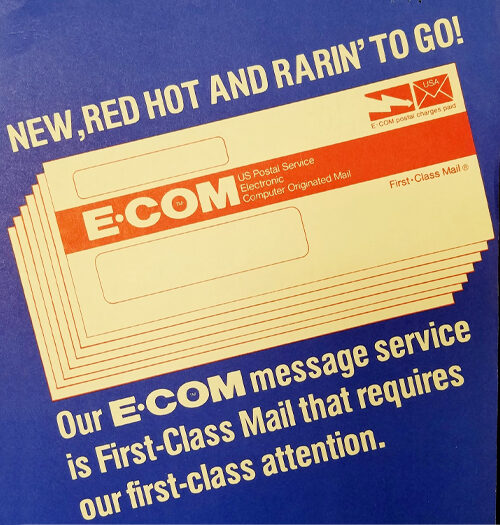
On Jan. 4, 1982, the Postal Service introduced E-COM, an attempt to harness the dawning power of digital communications for postal ends.
It worked like this: Business mailers transmitted messages to one or more of the 25 Post Offices in the program. The messages would be sorted by ZIP Code, printed out on bond paper, sealed in an envelope with a distinctive blue E-COM logo, and delivered to any recipient in the contiguous United States within two days.
Short for “Electronic Computer Originated Mail,” the E-COM program had some limitations from a business mailer’s point of view — including a minimum of 200 messages per transmission, a maximum of two pages per transmission, and an annual $50 service fee — but grew in each of its three years of existence.
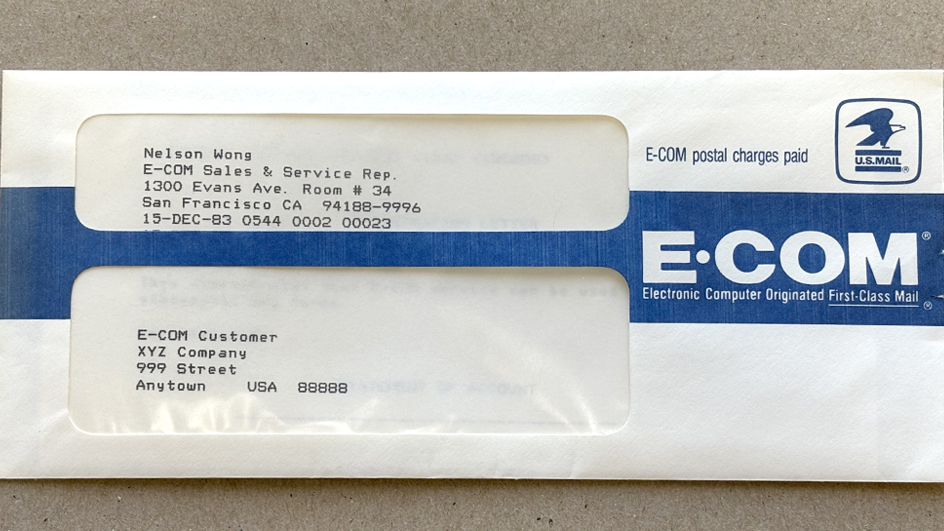
Last year, Buttondown, a newsletter software website, did a deep dive into the program and found that many users appreciated the service — including business mailers, who “valued the credibility that E-COM’s official, blue-and-white envelope lent.”
But regulatory battles over the money-losing program’s steep costs prompted the USPS Board of Governors to suggest selling or leasing the service to the private sector. No bids were high enough, however.
The program, whose first optimistic message was sent by Postmaster General William Bolger in 1982 (“We are very proud of this milestone in the history of the Postal Service”) delivered its final missive on Sept. 2, 1985, during the tenure of PMG Paul Carlin.
The “History” column appears occasionally in Link.