A very important envelope arrived at the Orlando, FL, Post Office in December 1954.
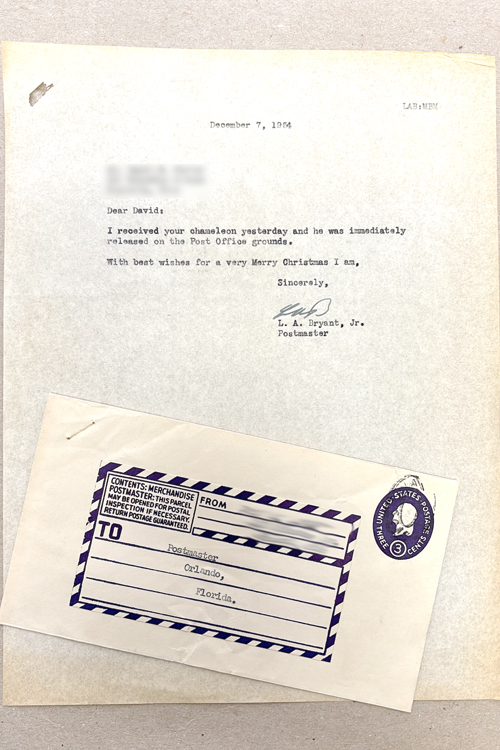
A young boy named David sent the postmaster a plea for help with his pet chameleon — who happened to be enclosed.
Ohio was getting too cold, David explained.
“Will you please let him loose. Could you let me know if he arrives there O.K. … I am so worried about him,” the boy wrote.
Thankfully, the stalwart reptile survived the long journey in the pre-stamped envelope, which was mercifully hand-canceled. Postmaster L.A. Bryant rose to the occasion and helped the critter complete the last leg of its 3-cent, one-way journey to sunny Florida.
“I received your chameleon yesterday and he was immediately released on Post Office grounds,” Bryant wrote back to David on Dec. 7.
The story of the letter, the lad and his lizard is remembered as a unique delivery in postal history.
Releasing a reptile in another state would probably be illegal today.
Additionally, USPS packaging would not fulfill U.S. Department of Transportation rules for shipping a chameleon, who falls under the “Small, Harmless, Cold-Blooded Animals” heading in Section 526 of Publication 52 — Hazardous, Restricted, and Perishable Mail. Such a container must be made of“275-pound test, double-wall, corrugated, weather-resistant fiberboard (W5c) or equivalent.”
The Postal Service also recommends including insulation when shipping cold-blooded animals and using the fastest method available.
The “History” column appears occasionally in Link.